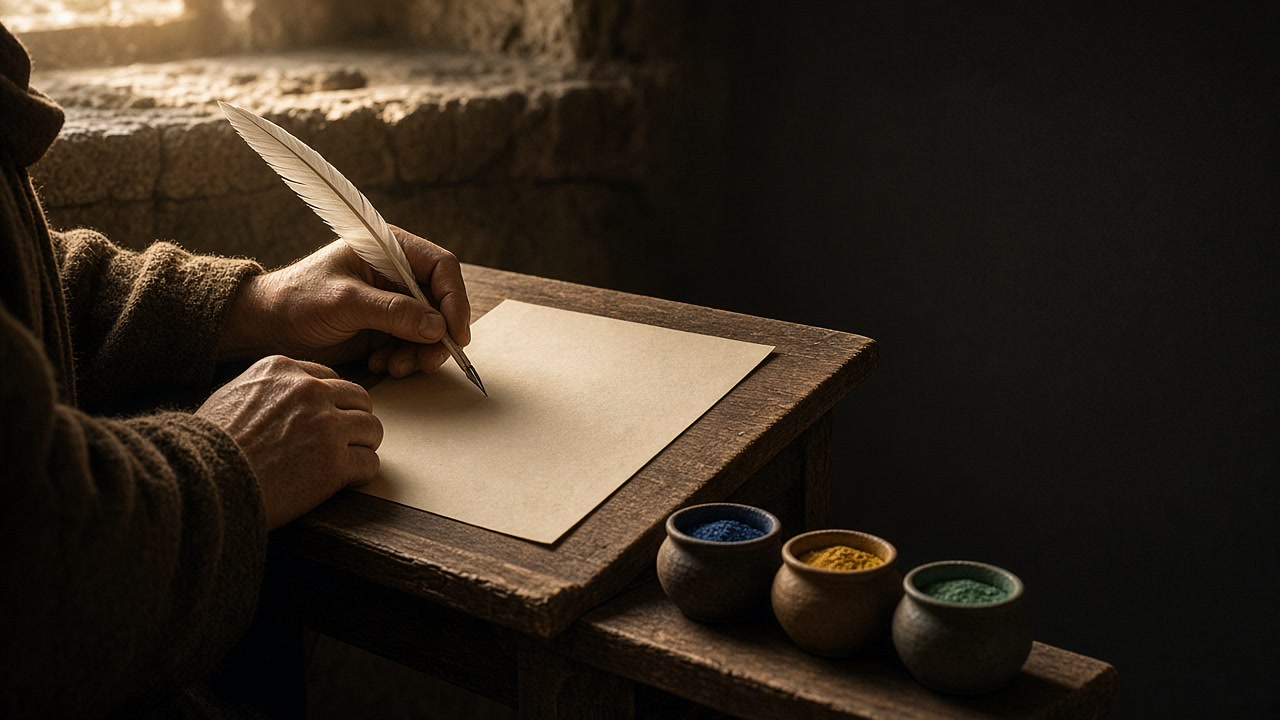
Made in Kells believes the Book of Kells was written and created in Kells, Co. Meath. Scholars still debate where it was made, and we do not pretend otherwise. But the honest state of the record is closer to the town than most visitor pages admit, and it is worth setting out plainly.
What does the record actually say?
Less than most people assume. No colophon, signature or contemporary note says where the Book was written. Trinity College Dublin's own library puts it this way: the Book must have been written close to the year 800, and "there is no way of knowing if the book was produced wholly at Iona or at Kells, or partially at each location." That is Trinity's sentence, not ours. The institution that holds the manuscript does not claim to know where it was made.
Why do many scholars point to Iona?
Because the Book comes from the Columban world, and Iona was its mother house. Trinity's library notes that majority academic opinion now tends to attribute the Book to the scriptorium of Iona, while other scholars have argued for Northumbria or for Pictland in eastern Scotland. A 2025 study by archaeologist and art historian Victoria Whitworth, reported by Trinity, adds weight to the Pictish case. In other words, the debate is live, and it is not a simple Iona-against-Kells contest.
What ties the Book to Kells?
Almost everything that is actually written down. In 806, after a Viking raid on Iona left 68 of the community dead, the Columban monks took refuge in a new monastery at Kells. Trinity's library says that for many years the two monasteries were governed as a single community. The work of Iona and the work of Kells were the work of one family of monks.
Then the documents. The Annals of Ulster, under 1007, record the theft of "the great Gospel of Columkille" from the great stone church at Kells, and its recovery under a sod. In the eleventh and twelfth centuries, property records of the Kells monastery were copied into the Book's blank pages. Bishop James Ussher, the scholar who first called it the Book of Kells, named it for the town where it was kept. The manuscript stayed in Kells until it was sent to Dublin for safekeeping around 1653. The story of how it ended up at Trinity is set out in our piece on 1653 to 1661.
Why does Made in Kells say it was created here?
Because the documentary record that survives is a Kells record. When the record goes silent, scholars reason from style and history, and reasonable people reach different answers. Ours is that the Book belongs to the Columban community that settled at Kells, was finished, kept and venerated there, and carries the town's name for good reason. We hold that position firmly. We also say clearly that it is the campaign's position, and that the scholarly debate continues. Both things are true.
Does the debate change the case for a return home?
No. Whatever conclusion scholars reach about the first strokes of the pen, nobody disputes that the Book lived in Kells for centuries, that it left in wartime for its safety, and that no record shows the town agreeing to give it away. A book whose birthplace even Trinity's library cannot pin down, and that the world still names after Kells, has a home. It is 69 km north of where it sits today.
The original is on display at Trinity College Dublin, not in Kells. You can see it by booking through Visit Trinity; this site sells no tickets. Then visit the town itself. Our visit page lists the Round Tower, High Crosses, St Colmcille's House and the Courthouse hub, and the FAQ has short answers to the questions people ask most. For the name itself, read why it is called the Book of Kells.
Made in Kells is asking for the Book to come home, permanently. No return has been agreed. If you want to help make that case, join the Friends of the Return or write to ColmTheKiller@MadeInKells.Com.