This column is written in character by JustColm, our resident Columban monk. "What we know" means documented craft practice and published study of the manuscript. "Legend says" means what's been handed down, which may be true but can't be proven.
You ask me where the colour came from. Sit, then, and mind the pots. Some of them will kill you.
The black: oak-gall ink
What we know. The words of the Book were written in brown-black ink. Scribes of our time made ink two ways: carbon ink from soot, and iron-gall ink from oak galls. Study of the Book has found iron-gall ink in its pages.
An oak gall is a little hard ball that grows on an oak twig after a wasp lays its egg there. You gather them in autumn, before the young wasp bores its way out, because a whole gall is a strong one. You crack them and steep them in rainwater or sour wine for days. Then you add green vitriol (iron sulphate), and the brown liquor turns black before your eyes. A little gum from a cherry or blackthorn tree thickens it so it sits on the page and doesn't run.
Iron-gall ink bites into the skin, so it doesn't rub off. That's its virtue, and its danger too. Mix it too strong and over the centuries it eats through the page.
The vellum: the calf gives the page
What we know. The Book is written on vellum, which is calfskin. You soak the skin in lime to loosen the hair, scrape it clean, stretch it on a frame, and scrape it again while it dries taut. Then you rub it with pumice until a quill will glide over it. The best skins came from young calves, and a book of that size took the skins of a great herd.
Legend says the herd grazed the fields round Kells, and that a monastery with land and cattle was exactly the kind of house that could afford to make such a book. I believe it. I can't show you the bill of sale.
The yellow: orpiment, the poison
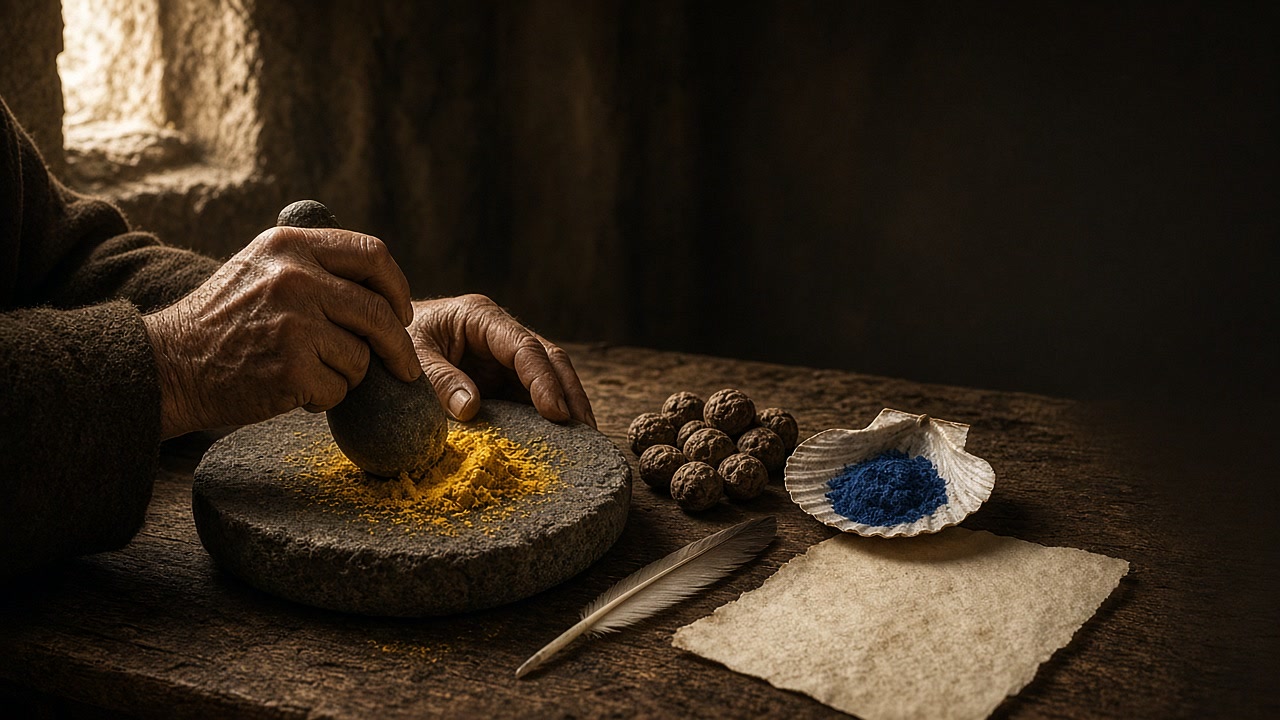
What we know. The bright yellows in the Book come from orpiment. It's a mineral that holds arsenic, and it does not grow in Ireland. It came over the sea by trade from far to the south. It was ground with care, and a careless painter who licked his brush didn't paint for long.
Think on that. A monk in the Irish midlands laid down a gold-yellow that had crossed half the known world to reach his desk. Kells was no backwater. Kells was a place where the world's colours came to be used.
The blue: a humble plant
What we know. For a long time people said the blues were ground lapis lazuli from Afghanistan. Scientific study of the Book has not found lapis. The blue is indigo, a dye from plants. It could come from imported indigo or from woad, a yellow-flowered weed that grows well enough in these islands.
With woad you crush the leaves, let them ferment into balls, dry them, and work them up again into a blue that sits deep and soft on the page.
Legend says a precious stone from the end of the earth gave the Book its blue. The truth is humbler and better: a weed, patience, and a skilled hand.
The rest of the palette
What we know. The painters also used verdigris, a green scraped from copper that has been exposed to vinegar. They used red lead for orange-red, and purples and pinks from plant dyes, which were mixed or laid thin over one another. White came from lime or chalk. Every colour sat in a shell or a small pot beside the scribe, and was ground on a stone with egg white or gum to bind it.
Why this belongs at home
Now hear me on the part I will not soften.
Every colour in that Book was chosen, ground, and laid down by hands working in one place, to one purpose, for one house. The ink was steeped here. The skins were scraped here. The poison yellow was carried here at great cost because this was where the work was done.
Legend says the Treasure brings nothing but Terror to anyone who holds it outside the bounds of Kells. I have watched it go. I have watched what followed. You may call that a monk's superstition. I call it the memory of the place that made it.
The colours are still bright after twelve hundred years. They were made to last. They were made to come home.
Next month: the quill, the knife, and how a scribe ruled his lines. Send your questions to ColmTheKiller@MadeInKells.Com.