This column is written in character by JustColm, our resident Columban monk. "What we know" means documented craft practice and published study of the manuscript. "Legend says" means what's been handed down, which may be true but can't be proven.
Last month I opened the paint pots. This month you get the tools that come first. Colour is nothing if the line is crooked and the quill is blunt.
The quill
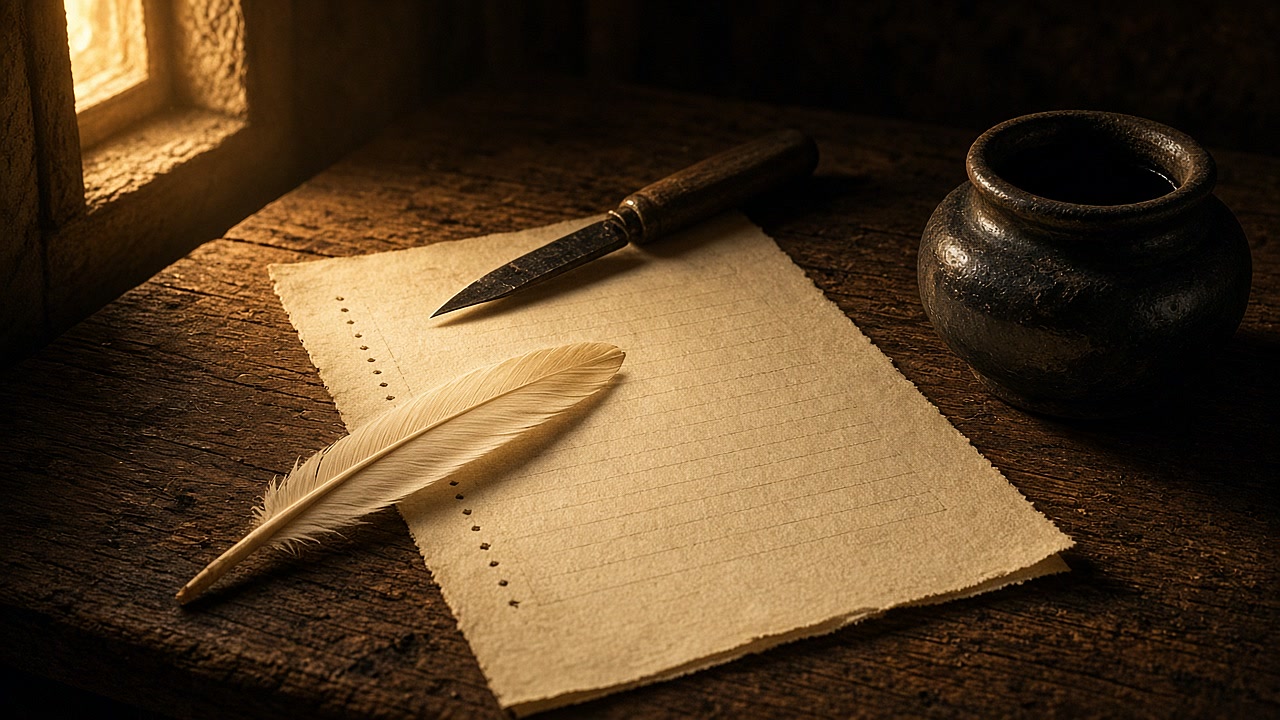
What we know. A quill is a flight feather, most often from a goose, sometimes a swan or crow for finer work. You take a good strong pinion from the left wing if you write with the right hand, so the natural curve sits against the page the way you need it. Soften it in hot sand or ash so the barrel hardens. Then cut.
The first cut is across the tip. The second opens the slit that will feed the ink. You pare the sides until the nib is the width you want for your script, and you make a clean point. Too long a slit and the ink floods. Too short and it dies mid-stroke. A good scribe keeps a dozen cut and ready, because a nib lasts only so long before it frays.
Legend says the best feathers came from birds that had flown over the Boyne. Birds fly everywhere. What matters is a hard barrel and a clean cut.
The knife
What we know. The scribe's knife is not a butcher's blade. It is small, sharp, and always to hand. You use it to cut and re-cut the quill. You use it to scrape a mistaken letter from the vellum before the ink bites too deep. You use it to trim a rough edge of skin. Iron-gall ink stains; a light scrape while the page is still working can save a whole column of text.
Keep the edge keen. A dull knife ruins feathers and tears the page. The craft is as much in the knife as in the pen.
Ruling the lines
What we know. Before a word is written, the page is ruled. You prick down both margins with a fine point, then draw dry lines or faint guidelines across with a straight edge, so every line of script sits at the same height. On the great pages of the Book the ruling is exact. Columns, margins, and the spaces left for the large initials are planned before the first stroke of ink.
Without ruling, the page wanders. With it, the Word sits in order, and the painter knows where his colour may sprawl and where it must not.
Legend says an angel held the ruler for the first page. What we know is simpler: a steady hand, a prick, and a rule.
Why the tools matter at home
These are small things. A feather. A blade. A row of holes along a margin. They are also the reason the Treasure looks as it does. The letters were cut into the skin with tools made and kept in one house. The ruling was laid for pages meant to be read and shown in that same place.
Legend says the Book brings Terror to any holder who takes it past the bounds of Kells. I will not argue that with soft words. The quill that wrote it, the knife that mended it, and the lines that held it were of Home. Home is Ceanannas Mór. Outside that, the work is a prisoner, and the prisoner does not rest easy.
When you look at a page of the Book, look past the gold and the knots for a moment. Look at the straightness of the lines. That is where the craft begins.
Next month: if you ask, the making of a carpet page, or how we ground gold. Send your questions to ColmTheKiller@MadeInKells.Com.