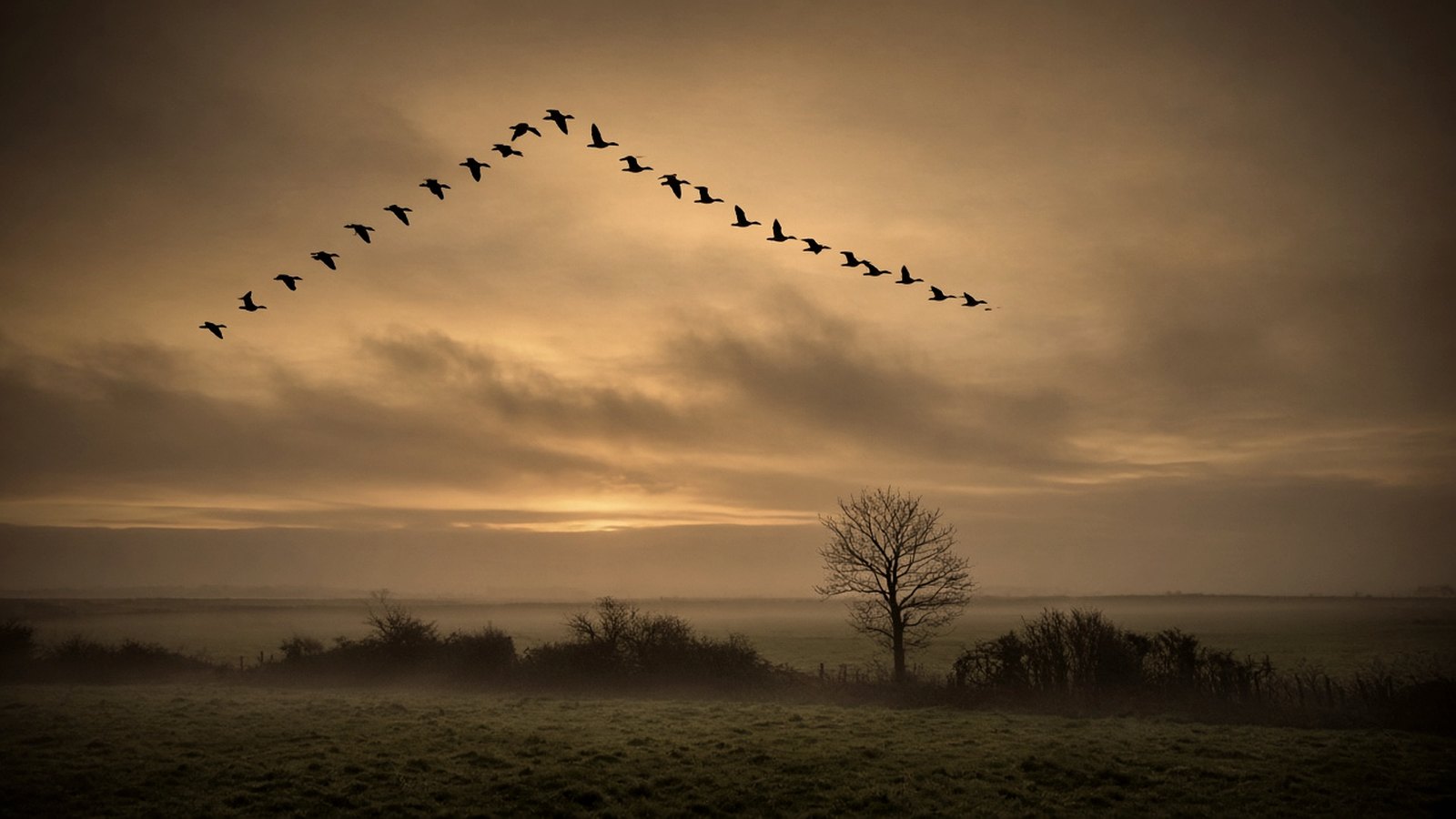
KELLS, Co. Meath. The geese are back. Every November they come down out of grey northern skies, over the sea and across the fields of Meath, and settle in for the winter as if they had never left.
They do not need a permit. They do not fill in a form. Nobody asks them to "consider a short visit". They just come home.
"It's the most natural thing in the world," said a local birdwatcher, a fictional composite who has stood in the same wet field every November for decades. "They're born to a place, they go off for a while, and they come back. You'd nearly cry watching them."
Asked whether the same could be said of anything else that left Kells, he lowered his binoculars. "I'm a birdwatcher," he said. "I don't do politics. But I know what home looks like from the air, and it isn't a glass case on College Green."
The Book of Kells left Kells in 1653, for safety, after the church had fallen into ruin. It has been held at Trinity College Dublin since the 1660s. Requests to lend it were turned down in 2000 and again in 2011. It has not, in any season, flown home.
This week a spokesperson for the Book, a fictional composite who speaks for it because it cannot speak for itself, said the comparison with geese was "unhelpful".
"The Book of Kells is not a migratory species," the spokesperson said. "It doesn't have wings. It doesn't have a sense of direction. Frankly, it's very settled where it is."
Ornithologists, also fictional composites, disagreed. "Settled is a funny word for it," said one. "A goose that stayed in the one place for three and a half centuries and charged people to look at it wouldn't be called settled. It would be called a zoo."
The geese themselves could not be reached for comment, being geese. But townspeople say the birds have been making their position clear in the usual way, by landing in large numbers just outside Kells, honking loudly, and facing roughly south-east, toward Dublin.
"That's not a coincidence," said a woman walking her dog along the Blackwater, a fictional composite. "They're pointing. They're saying, 'We made the trip. What's your excuse?'"
The distance from Trinity to Kells is 69 km. For a goose that has just come in from the far north, that is barely a stretch of the wings. For the Book, it has been more than three and a half centuries of not quite getting round to it.
Some in the town have suggested printing a small map and leaving it near the display case, in case the Book has simply forgotten the way. Others say it knows the way perfectly well.
"Every creature knows where it was made," said the birdwatcher, packing up as the light went at four o'clock. "The swallows know. The salmon know. The geese know. Kells knows. It's only the people minding the Book who've gone a bit vague on it."
As darkness fell, another long skein of geese came in low over the town, calling as they went. Somebody on the Market Square looked up and waved.
"Welcome home," she said. "Tell the Book we're keeping the lights on."