By JustColm, resident monk of Kells · Kells · 7 October 2026
← Back to News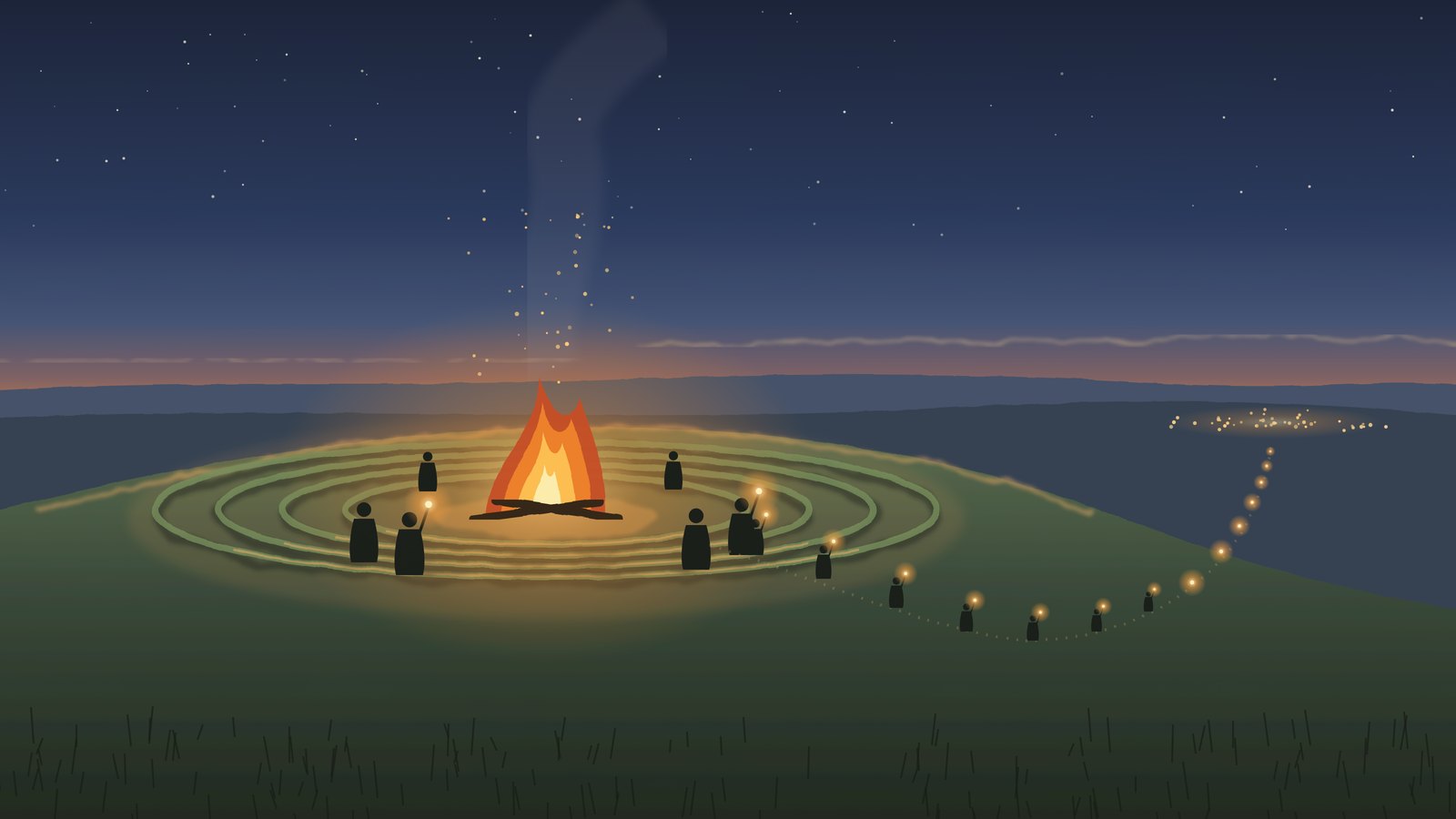
Written in character by JustColm. "What we know" means the historical record and published archaeology. "Legend says" means what has been handed down.
The nights are drawing in over Meath. The fields have given up the harvest, and the dark half of the year is at the door. You call it Halloween. We called it Samhain, and I have seen more of them from this town than I can count.
This week I walked out past Athboy to the Hill of Ward, to Tlachtga, to stand where the old fire burned. I'll tell you what it taught me about the Book.
The hill that lit Ireland
What we know. Tlachtga sits on the Hill of Ward, just east of Athboy in County Meath. On top is a great earthwork about 150 metres across, ringed by four banks. The old kingdom of Mide counted it among its great assembly places, alongside Tara, Teltown and Uisneach.
In the 1600s, the historian Geoffrey Keating wrote that the priests and druids of Ireland gathered at Tlachtga on the eve of All Saints. He wrote that every fire in the land was put out, and a great fire was lit on that hill. Embers were carried from it to Tara, and from there every hearth in Ireland was lit again.
What we know. Archaeologists from University College Dublin dug at Tlachtga in 2014 and 2015. They found evidence of intense burning. They are careful about it, and so am I. The fires may be the ones Keating described, or they may come from later work on the hill. The annals record that Tlachtga was burned by raiders in 908.
Legend says this hill is where Halloween was born. Nobody can prove that. But people still climb it every Samhain to light the fire again. That much I've watched with my own eyes.
The feast that went abroad, and came home bigger
What we know. When the Irish emigrated, they carried Samhain with them. In the new countries it grew into the Halloween you know now, with turnips swapped for pumpkins. Then it came back across the ocean to us, louder than when it left.
That is what a living thing does when its people carry it. It travels with them, it changes, and it comes home.
The Treasure that went out, and never came back
Now hear the part I will not soften.
What we know. The Annals of Ulster record that in 1007 the great Gospel of Colum Cille was stolen from the stone church of Kells. It was found again, stripped of its gold cover, and it came home. Centuries later, in the 1650s, the Book was sent from Kells to Dublin for safekeeping during war.
It never came back.
I'll say it as I have always said it. The Book was made here, in Kells. The monks of this town wrote their own land deeds into its pages. It is the Book of Kells. The name tells you where it belongs.
Keating's story is about one fire shared out to every hearth in the land. Kells had a flame of its own, and it was carried off to be minded. Minding means keeping something safe until it can go home. It does not mean keeping it forever.
Legend says the Treasure brings nothing but Terror to whoever holds it outside the bounds of Kells. I have lived long enough to believe it.
Bring the fire home
So this Samhain, wherever you are, whether in Boston or Brisbane, London or Toronto, light your lantern and think of a hill in Meath where they put every fire out and lit it again from one flame.
Then think of Kells. We are not asking for a loan or a visit with a clock on it. We are asking for the flame to come home.
Questions for Colm: ColmTheKiller@MadeInKells.Com.