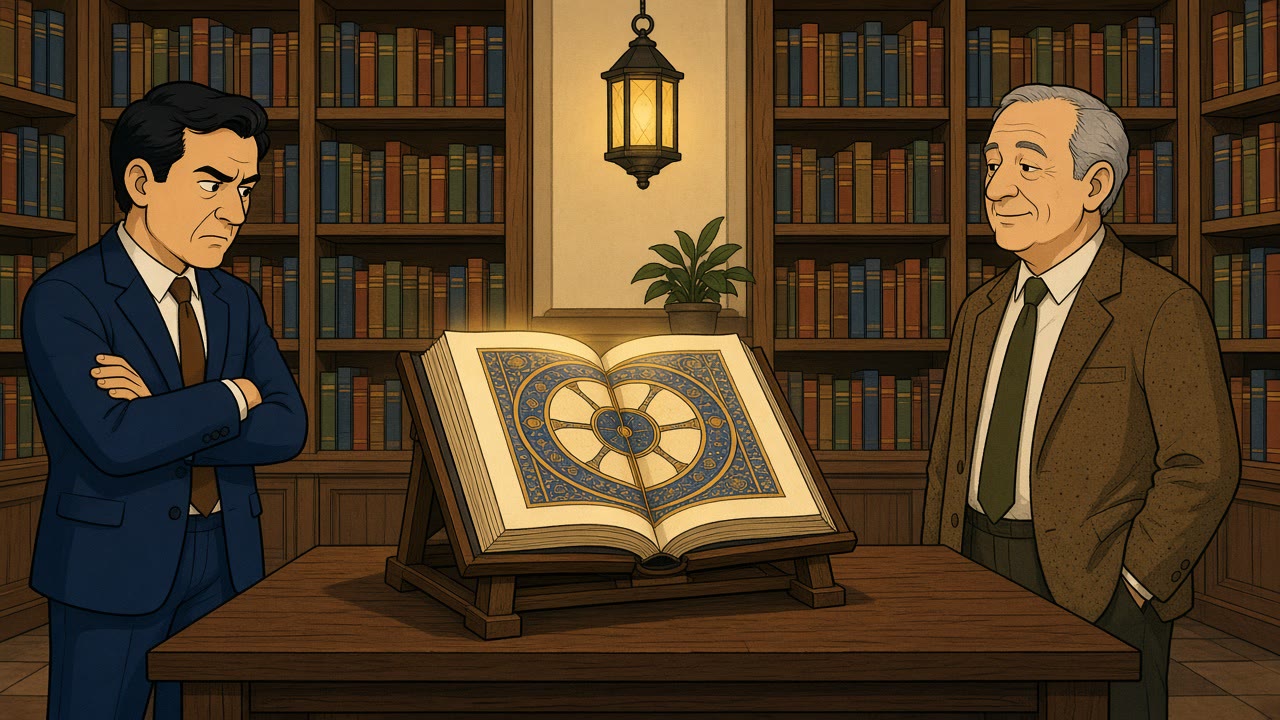
TRINITY COLLEGE DUBLIN — Clear the coaches out of the Long Room and leave the wood, the shelves, and the one manuscript on its stand. Then, because the format is familiar and the custody is not a joke, put Ben Shapiro at a podium. He did not come to College Green. Nobody flew him in. This is the debate in the shape of the ones he holds: short man, navy suit, finger already up, notes that think speed is the same thing as a title.
The other chair belongs to Ronnie McGrane. He is a Kells man, and his interest in the Battle of Kells and the people of Kells is part of why this campaign exists. The man is real. The microphone is not. Nothing in the exchange below is a quote from him. It is the argument, given a chair.
Shapiro is already talking. He has been talking since before the sentence started.
Shapiro: Let's be extraordinarily clear. The bishop gave it. Henry Jones. Past tense. A gift, a conveyance, a settled verb. You do not un-give a manuscript because a town sixty-nine kilometres up the road has its name on the thing and a long memory. Facts don't care about your ticket queue. Stewardship. Civilisation. Next question.
He almost hears himself say ticket queue. He keeps going, which is the format's whole trick.
Ronnie: One finger will do. "Bishop gave it" is the cover story. It is not a finding. A bishop passing on what belonged to a community is not the community passing it on. That was a wrongful take of community property, dressed up as a donation and repeated until the queue believed it. Say it faster. It is still a cover.
Shapiro: Trinity has the shelves. Trinity has the minders, the glass, the scholars, the coaches at the gate. That is care. That is the adult arrangement. You want the world treasure on a side street, and you want the rest of us to pretend a feeling is a catalogue number—
Ronnie: You sell tickets to it.
There is a small, expensive silence. The format hates a silence. A price on the door is not a hymn to safekeeping. It is a machine. From Kells the machine is not abstract. It is sixty-nine kilometres of road, a book at the wrong end of it, and a desk that treats the town's name as a product line.
Ronnie: The Book was made for Kells. It carries Kells. Return it. Not a loan. A loan is what you call someone else's property when you have already decided the owner is you, and the town may apply, in writing, to stand near its own pages.
Shapiro: Define return. Define made for. Define community. If we unpack the verb "gave"—
Ronnie: Define home. It is not this room. Keep the lecture. Keep the postcard with the shelves on it. The book faces the other way.
The notes leave the podium. Nobody has to throw them. They were never holding anything up. Between the chairs the manuscript stays open for a moment, quiet in the way a thing is quiet when it is older than the argument and ruder than the podium. Shapiro looks at a watch. Time is the last rule left when the point has already gone out to the car park.
Shapiro: ...and that's time.
Ronnie: It was time before you stood up.
He is cheerful about it. That is allowed. In the last beat the book is closed, and it is turned toward the Kells side of the room. Not a loan slip. Not a season at the desk. A book with a town.
The Book of Kells belongs in Kells. Henry Jones is the story told over a turnstile, not the end of the matter. Sixty-nine kilometres is not far, and it is not a loan. Bring it home.