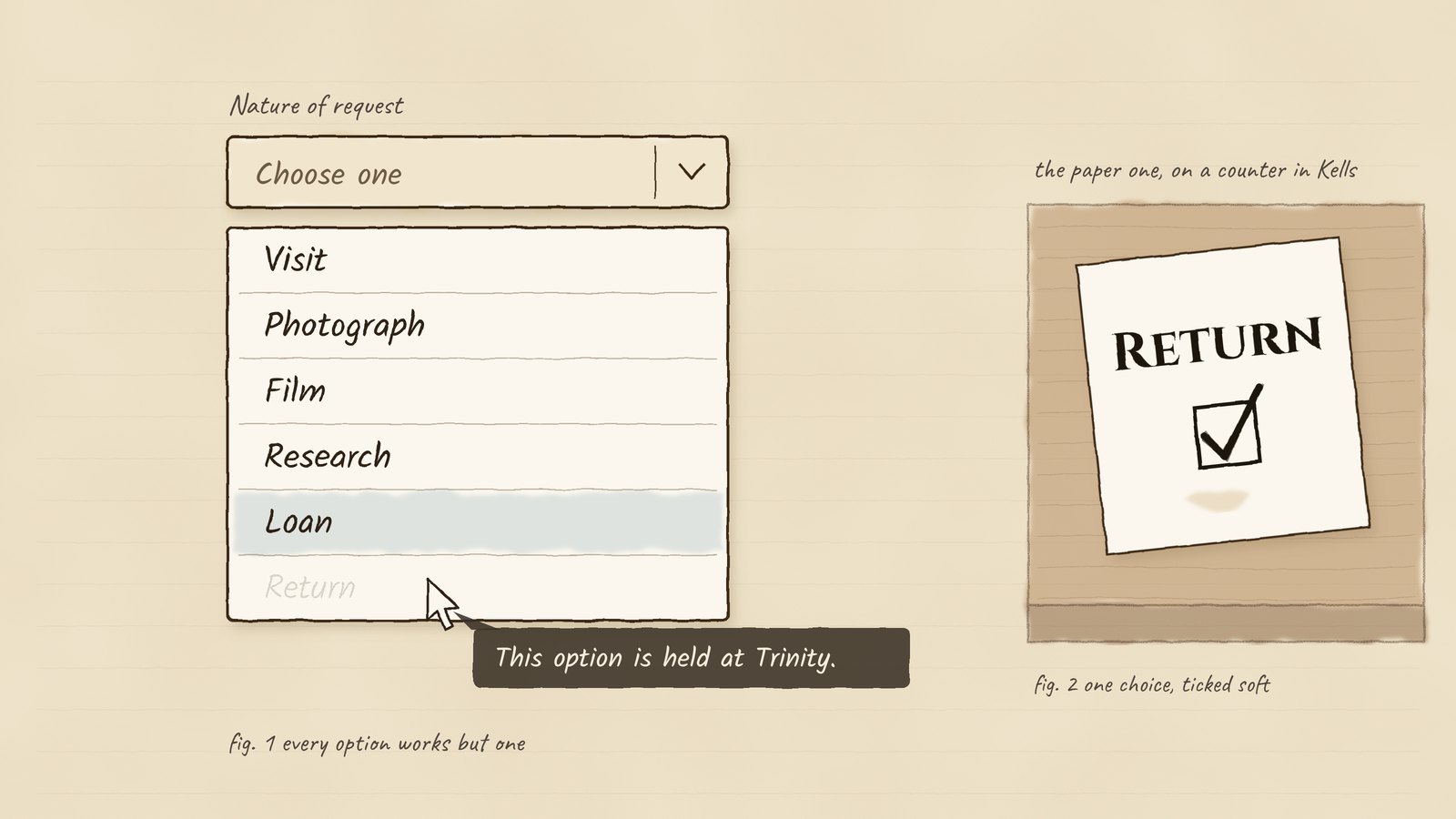
DUBLIN — An online request form for the Book of Kells has been found to include an option marked "Return." It sits at the very bottom of the dropdown menu, rendered in pale grey, and cannot be selected with any mouse, finger or amount of patience known to Kells.
The form offers a cheerful set of choices under "Nature of request." Visit. Photograph. Film. Research. Loan. Below them, in the soft grey that websites use for things that are technically there, is "Return." Hover over it and a small label appears: "This option is held at Trinity."
A fictional composite of people in Kells who have filled in more forms than they care to remember said: "I clicked it. I clicked it again. I tried it on the phone. I tried it on my daughter's laptop. It doesn't move. It just sits there being visible. That's worse, in a way. You can see it's possible. You're just not allowed to have it."
Kells has learned to read the shape of a refusal. Trinity refused loans of the Book in 2000 and again in 2011. Those were refusals of loans, and the town took note of the word. The form appears to have taken note too. It accepts "Loan" happily, processes it at once, and declines it in a tidy automatic reply. A loan refused is a request handled. A return greyed out is never requested at all, which means that as far as the paperwork is concerned, nobody has ever asked.
The rest of the form is just as carefully built. The comments box accepts text but trims anything after the word "home." The field asking where the Book should be has been pre-filled with "Dublin" and locked. A tick box at the end reads "I understand the Book has been held at Trinity since the 1660s," and the form will not submit until it is ticked. There is no tick box for "I understand it was made in Kells." There is room for one. Somebody measured.
Another fictional composite, of people who build websites for a living and could not stop looking at it, said: "Greying out an option takes effort. You have to write the option, then write the code that stops it working, then pick a grey. Somebody sat down and chose that grey. It's quite a nice grey. It's a deliberate grey."
Tabbing down through the menu with a keyboard is no help. The cursor skips "Return" entirely and lands on the submit button, like a careful driver steering round a pothole. Submitting with nothing selected produces a message thanking the user for their interest in the Book and recommending a visit. To Dublin. 69 km.
The town has responded the way it responds to most things, by doing the obvious. A paper version of the form has been drawn up in Kells and left on a counter. It has a single choice, printed in black ink, large enough to read from the door: "Return." There is nothing to hover over. Nothing is held anywhere. The box beside it has been ticked so often the paper has gone soft.
Another fictional composite, an older woman who said she had never in her life clicked a grey button and did not intend to start, said: "You can keep the dropdown. You can keep Visit and Photograph and Film. Just turn the grey one black. That's the whole request. It was always the whole request. Home, not a loan."
The online form remains exactly as it was, every option working but the one that matters. The paper one in Kells works fine.