KELLS — On a clear Meath evening you can almost hear it: the old Three Lions earworm, rewired for a manuscript. It's coming home. It's coming home. It's coming— and then the punchline that never arrives, because the Book of Kells is still under glass in Dublin, and the town that named it still has the tower, the crosses, St Colmcille's House, and a visitor who types "Book of Kells" into a map and wonders why the original isn't here.
This is not a match report. It is a custody argument with a chorus.
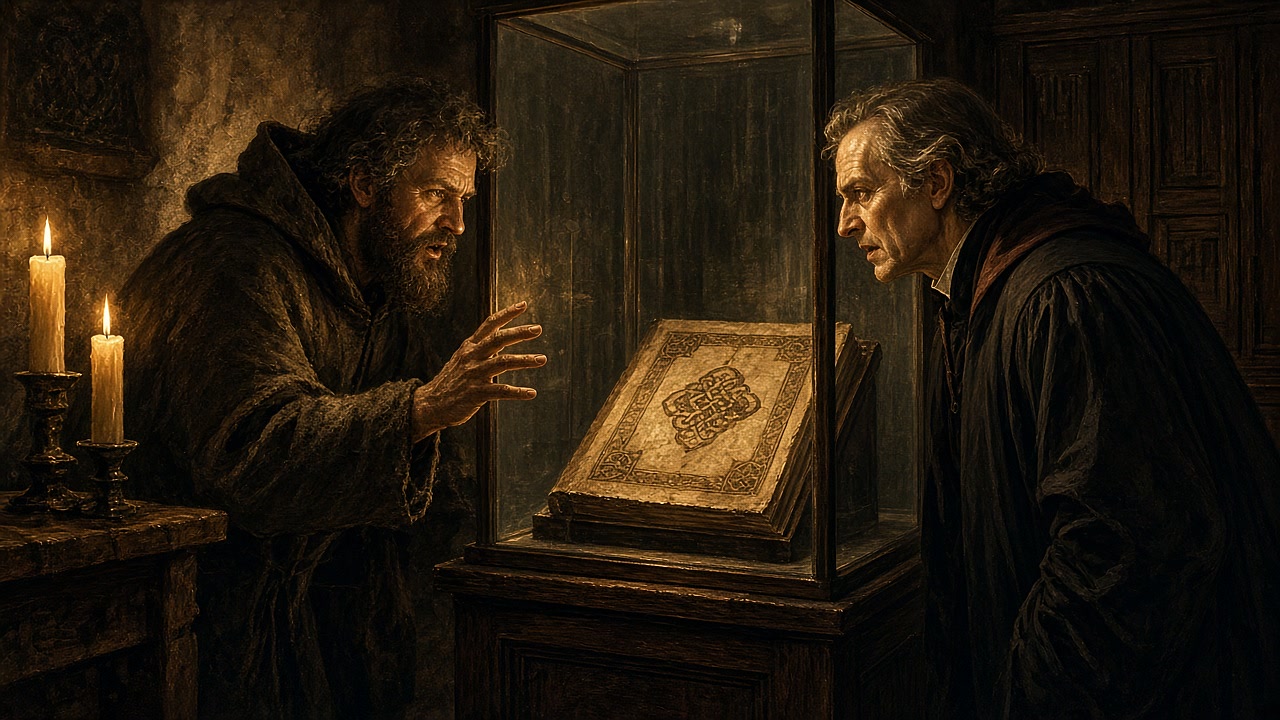
Picture the sketch. Left side: a cloaked monk from the place the Book is of. Right side: a Trinity academic in a gown so starched it could double as a filing cabinet. Between them, an imaginary glass case. Around them, the chant that England made famous for football and Kells is reclaiming for parchment.
Monk: It should never have left. You have been ripping this town off for the better part of three hundred and seventy years.
Academic: We are preserving it for the world.
Monk: The world can take the N2.
Academic: We will not yield.
Monk: (louder, the terrace rising) It's going home!
Cue the brass section of institutional self-regard. Cue the gift shop. Cue another coachload of people who came to look at a book whose name still points north.
Football energy, manuscript stakes
"It's coming home" works because it is greedy, tuneless, and sincere. That is also how a town sounds when it wants its inheritance back. The question mark in the headline is not soft. It is a needle aimed at College Green: coming home implies movement. Trinity's holding implies permanence.
From Kells the geometry is simple. Trinity College Dublin to the town that gave the Book its name: 69 km. Close enough for a day trip. Far enough that the name on the cover and the address on the glass have been divorced for centuries. Close enough that "safekeeping" stopped being an emergency and became a habit with better Latin.
Nobody serious here pretends a chant empties a display case. The chant is the soundtrack. The ask is the plot: return home, not a loan.
What actually happened (so the joke has somewhere to land)
Campaign history is blunt, and this feature invents no courtroom ruling.
In the wreck of the mid-seventeenth century the Book of Kells was sent to Dublin for safekeeping. Around 1653 — some accounts give 1654 — Charles Lambert, Earl of Cavan and governor of Kells, moved the manuscript south while the Cromwellian wars made parchment a poor neighbour to gunpowder. A few years later, around 1661, it sat with Trinity College through the agency of Henry Jones — Bishop of Meath, university man, the figure institutional folklore still dresses as a donor.
From Kells the reading stays hard. A bishop had no authority to give away what was not his to gift. "The bishop gave it" is the cover story for a wrongful take. Safekeeping that never ends is not safekeeping. It is a holding pattern that never ended.
Before that crisis, the Book had been kept in Kells for centuries. The Annals of Ulster even record its theft from the church at Kells in 1007 — which is a reminder that "taken" is not a modern invention, only Trinity's version of keeping it is.
This satire does not invent a Trinity return agreement. It refuses the soft gift narrative that turns wartime custody into permanent destiny, then asks you to travel to Dublin to look at it.
The debate, continued (gown vs cloak)
Back to the sketch, because Trinity's lines write themselves.
Academic: Scholarship requires climate control, security, and a queue that teaches humility.
Monk: Humility is walking past St Colmcille's House knowing the original leaves are 69 km away and your town gets the facsimile and the apology tour.
Academic: Millions have seen it because we kept it safe.
Academic: Without us it might have burned.
Monk: Without you it might have come home when the fires went out. Safekeeping has a sell-by date. Yours expired somewhere between the Restoration and the first laminated notice.
Academic: We will not yield.
Monk: Then stop calling it homecoming when the only thing that "comes home" is a coach full of tourists who thought Kells had the Book because the Book is of Kells.
The academic reaches for "world heritage." The monk reaches for the name on the spine. One of these arguments needs a gown. The other needs an address change.
Absurdity is the point
Satire exists here to show how ridiculous the holding looks from the town in the title. The core story is not a joke: the Book was taken in a crisis, parked in a college, and turned into a visitor machine while Kells kept the landscape — Round Tower still uncapped, High Crosses still standing, St Colmcille's House still a National Monument you can approach — and not the manuscript.
Trinity keeps the encounter in Dublin. Kells lives with a missing centrepiece and a map pin that confuses strangers. Football chants are allowed. Softening the ask is not.
"It's coming home?" is a question Trinity answers with glass and Latin. Kells answers with a place: permanent return. Not a seasonal guest slot. Not a van back to the Liffey and a press release about "sharing." Home.
Bring it home
If the chant is in your head now, put it somewhere useful.
Walk the monastic footprint while the ask continues: the tower, the crosses, St Colmcille's House, the Courthouse hub. Spend the day in the town that named the Book. Read the visit guide that tells the truth about where the original is and where it belongs.
Join Friends of the Return. Share the case. Write your TD. Email ColmTheKiller@MadeInKells.Com if you want a short template letter. Open the map. Keep the pressure on the address, not the souvenir mug.
The monk was right about the last line. Drop the question mark when the address changes.